
Trump Asserts Absolute Authority Over Cuba as Island’s Grid Collapses

President Donald Trump on Monday asserted absolute authority over the future of Cuba, declaring that he has the “honor” of “taking” the neighboring island and dismissing decades of diplomatic precedent with a blunt assertion of executive power, “I can do anything I want” with the carribbean nation.
The President’s comments, delivered during an Oval Office signing ceremony, represent a seismic shift in American foreign policy. Since the 1962 Cuban Missile Crisis, 12 successive U.S. presidents have honored a pledge to the former Soviet Union not to invade the island. Trump’s rhetoric suggests that the Cold War-era consensus, and the legal boundaries that maintained it, is being dismantled in real-time.
“I do believe I’ll be... having the honor of taking Cuba. That’s a big honor. Taking Cuba in some form,” Trump told reporters. When pressed on the legal or strategic nature of such an action, he added, “I mean, whether I free it, take it. Think I can do anything I want with it. You want to know the truth.”
A Strategy of Collapse
The President’s verbal escalation comes as Cuba faces its most dire existential crisis since the 1959 Revolution. Following the recent capture of former Venezuelan President Nicolás Maduro and a subsequent U.S. oil blockade, the island’s economy has effectively ground to a halt.
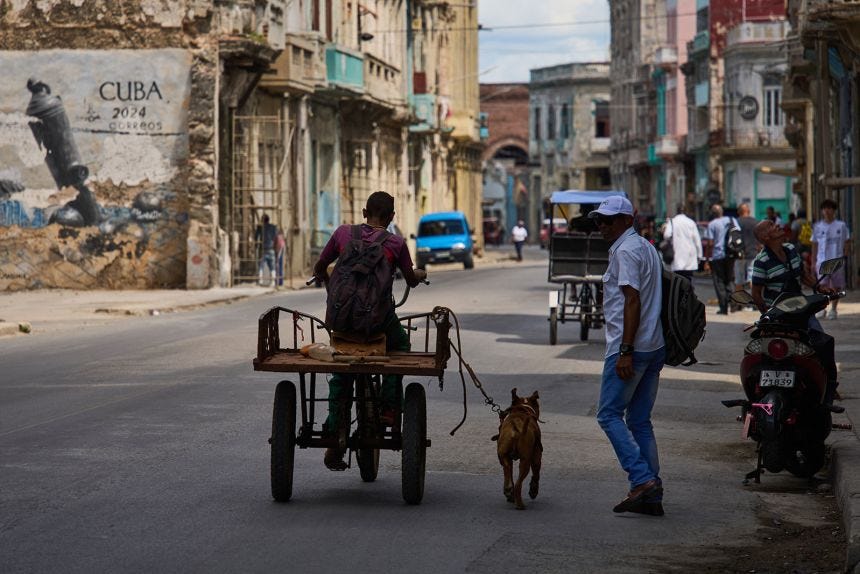
On Monday, the Cuban electric grid collapsed entirely, leaving 10 million people in darkness. Hospitals have reported an inability to perform surgeries, and schools have been shuttered as the country faces its third month without a significant oil shipment.
The administration’s “maximum pressure” campaign appears designed to force a total systemic failure. Sources familiar with ongoing bilateral talks say U.S. negotiators have signaled that the removal of Cuban President Miguel Díaz-Canel is a non-negotiable objective.
The View from Havana
In Havana, the rhetoric is being met with a mix of defiance and a desperate pivot toward the West. President Díaz-Canel, who succeeded the Castro brothers in 2018, insisted that any talks must occur under “principles of equality and respect” for sovereignty.
However, the severity of the crisis has forced the Communist leadership to make unprecedented concessions. To bypass the blockade, Havana is now reportedly inviting Cuban exiles to invest in and own large-scale businesses on the island, an attempt to create a domestic U.S. lobby to counter Trump’s “Anything I Want” doctrine.
Constitutional and Regional Risks
For the American public, the President’s remarks raise urgent questions about the limits of executive power and the potential for a new military entanglement just 90 miles from Florida.
The White House has not yet detailed a legal basis for a potential intervention, which would likely face challenges under the War Powers Resolution of 1973.
Historically, a total social collapse in Cuba triggers mass migration events. Experts warn that if the grid stays dark and the blockade remains, the U.S. could face a humanitarian crisis on its own shores that dwarfs the Mariel boatlift of 1980.
After moving against leadership in Venezuela and Iran, Trump has openly mused that Cuba is “next” on his list of geopolitical corrections.
As the administration continues to squeeze the island’s energy supply, the President’s assertion of absolute authority has set the stage for a confrontation that is no longer just about the fate of the Caribbean, but about the very definition of American presidential power in the 21st century.
Thanks for checking out The Kicker with Ashlee Banks. Let me know your thoughts below.
For more news be sure to subscribe to The Kicker and follow Ashlee Banks on Twitter, TikTok and Instagram @ashleembanks.
Thank you for providing this concise & well written summary of the severe consequences from such alengthy oil blockade on Cuba's electricity grid and citizens.