

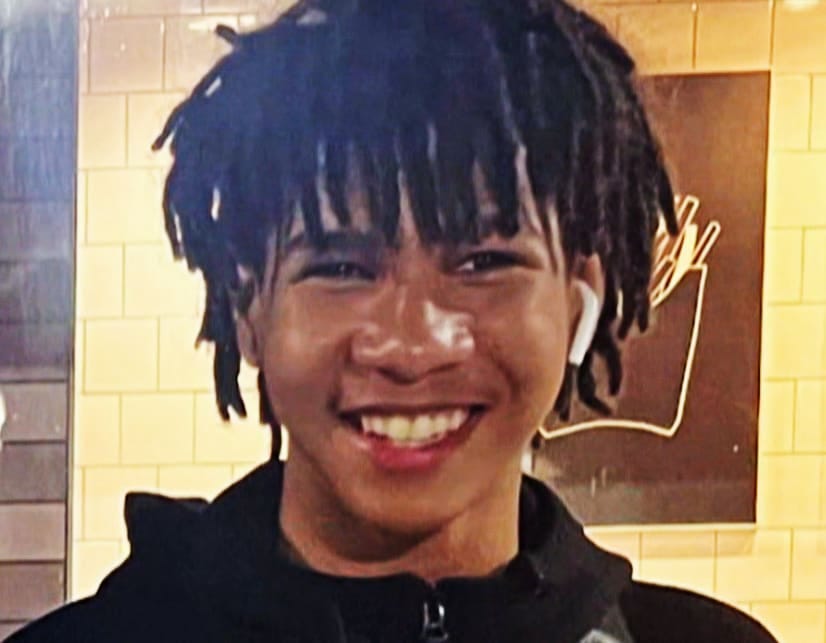
The video data was absolute, the forensic science was clear, and the victim was a child shot in the back while retreating. Yet, on June 1, 2026, after eight hours of deliberation following a five-day trial, a Richland County jury found convenience store owner Chikei Rick Chow, 61, not guilty of murder in the shooting death of 14-year-old Cyrus Carmack-Belton.
The teen’s death exposes a system where digital, objective proof can be entirely bypassed by a subjective narrative of fear and it reopens a raw, decades-old wound regarding multiracial tension, property over life, and the vast divide between criminal and civil justice.
The Anatomy of the Chase: The Uncontested Facts
The tragedy occurred on May 28, 2023, outside a Shell gas station on Parklane Road in Columbia, South Carolina. Inside the store, Rick Chow falsely accused Carmack-Belton of shoplifting four bottles of water.
Surveillance footage played for the jury showed a clear sequence: the teenager denied taking anything, shook out his pockets to prove his innocence, and walked out of the store. Investigators with the Richland County Sheriff’s Department later confirmed via security tape that Carmack-Belton hadn’t stolen anything.
The state argued that Rick Chow and his son, Andy Chow, illegally instigated the confrontation by exiting the business to hunt the teenager down. They pursued him roughly 130 yards down Springtree Drive. Eyewitnesses testified that they saw the minor running from the two adults and that he was not holding a weapon during the flight.
The definitive pivot point of the prosecution’s case was delivered by forensic pathologist Dr. Amy Durso. Her autopsy report revealed that the fatal bullet entered through Carmack-Belton’s back, traveled through his body, and struck his heart. Her testimony to the jurors was unequivocal:
“He was not shot from the front. He was shot from the back.”
The Micro-Second Defense and the Law of Fear
How does a defendant secure an acquittal for murder when the victim was an innocent child shot in the back while fleeing?
The defense successfully shifted the jury’s focus away from the 130-yard pursuit and fixed it entirely on a single micro-second. Defense attorneys Shaun Kent and Jack Swerling argued the case wasn’t about water bottles, but about what happened at the termination of the chase. They contended that Carmack-Belton possessed a handgun and pointed it at Andy Chow.
Andy Chow testified that he believed he was about to be killed, stating on the stand, “I thought he was going to shoot me.” While prosecutors acknowledged that a semiautomatic pistol was retrieved from the scene, they maintained it had fallen from the teenager’s pocket during the run and was never used to threaten the Chows.
Legally, Chow’s team had already lost a pre-trial Stand Your Ground immunity hearing because they were the initial aggressors who chose to leave their property and chase a minor. Yet, by deploying the “defense of others” doctrine, the defense bypassed the entire 130-yard chase. They convinced the jury that the moment Andy Chow felt a threat, Rick Chow was legally justified as a father to use lethal force.
Attorney Swerling stated after the verdict, “Anybody, any parent in that position would have done the same thing... It’s the oldest legal principle that exists, self-defense or defense of others.”
The Haunting Echo of 1991: Soon Ja Du and Latasha Harlins
The Chow verdict does not exist in a vacuum. It heavily mirrors one of the most inflammatory flashpoints in modern American history: the March 16, 1991, killing of 15-year-old Latasha Harlins in Los Angeles, California.
In that historic California case, Soon Ja Du, a 49-year-old Korean convenience store owner, falsely accused Harlins, a Black teenager, of stealing orange juice. Security footage proved Harlins had cash in her hand to pay. After a physical scuffle, Harlins put the juice on the counter and turned to walk away. Du pulled a revolver and shot Harlins in the back of the head from three feet away, killing her instantly.
While a California jury found Du guilty of voluntary manslaughter, trial judge Joyce Karlin famously commuted the prison sentence to five years of probation, 400 hours of community service, and a $500 fine, meaning Du served zero jail time. That sentence enraged Los Angeles’ Black community and became one of the catalysts for the 1992 L.A. Riots, during which thousands of Korean-owned businesses were targeted.
More than 30 years later, Carmack-Belton’s death reopens a complex, multiracial tension between immigrant merchants operating businesses within historically Black neighborhoods. It forces a raw dialogue about systemic bias, the hyper-criminalization of Black youth over minor property, and the recurring theme of non-Black store owners utilizing lethal force under the umbrella of “understandable fear.”
The Civil Arena: The Next Phase of Accountability
While the criminal justice system completely cleared Chow, his legal battle is far from over. Following the verdict, Carmack-Belton’s family attorney, Todd Rutherford, expressed absolute disbelief, stating, “There is no way that a child who did nothing wrong, who was shot in his back, how that jury can justify that verdict... I don’t understand it.”
Rutherford immediately announced that the family is aggressively moving forward with a civil wrongful death lawsuit against Chow, which had been put on hold pending the outcome of the criminal trial.
This civil route mirrors the path taken by the Harlins family, who secured a $300,000 insurance settlement against Soon Ja Du in July 1992. For the Carmack-Belton family, the civil suit is now the primary, remaining arena to establish a legal record of accountability for the death of their son.
Thanks for checking out The Kicker with Ashlee Banks. Let me know your thoughts below.
For more news be sure to subscribe to The Kicker and follow Ashlee Banks on Twitter, TikTok and Instagram @ashleembanks.
Ashlee Banks is an attorney licensed in Maryland, writing independently. This article does not constitute legal advice.
This clearly reminds me of the Kyle Rittenhouse murder trial, a verdict of 'not guilty', in spite of clear, conclusive evidence of murder.
I cannot help but think of this analogy in the NFL, concerning a completed pass, as a completion can be ruled incomplete if a receiver loses control of the ball for a fraction of a second.
I get the point that jurors cannot be held accountable for their decisions, but they should explain to the victim's family the reason for their verdict. I wonder, though, if there was something going on in that deliberation room...?